Regret €20 Gelato? Uncover Rome's Untouched Corners, Not the Crowds!
- Quick Tags: Rome budget travel, Niche Italy destinations, Rome food guide, Avoiding tourist traps Rome
- Editor: Chloe Jones
- Updated: Aug,12,2026
- Views: 263k









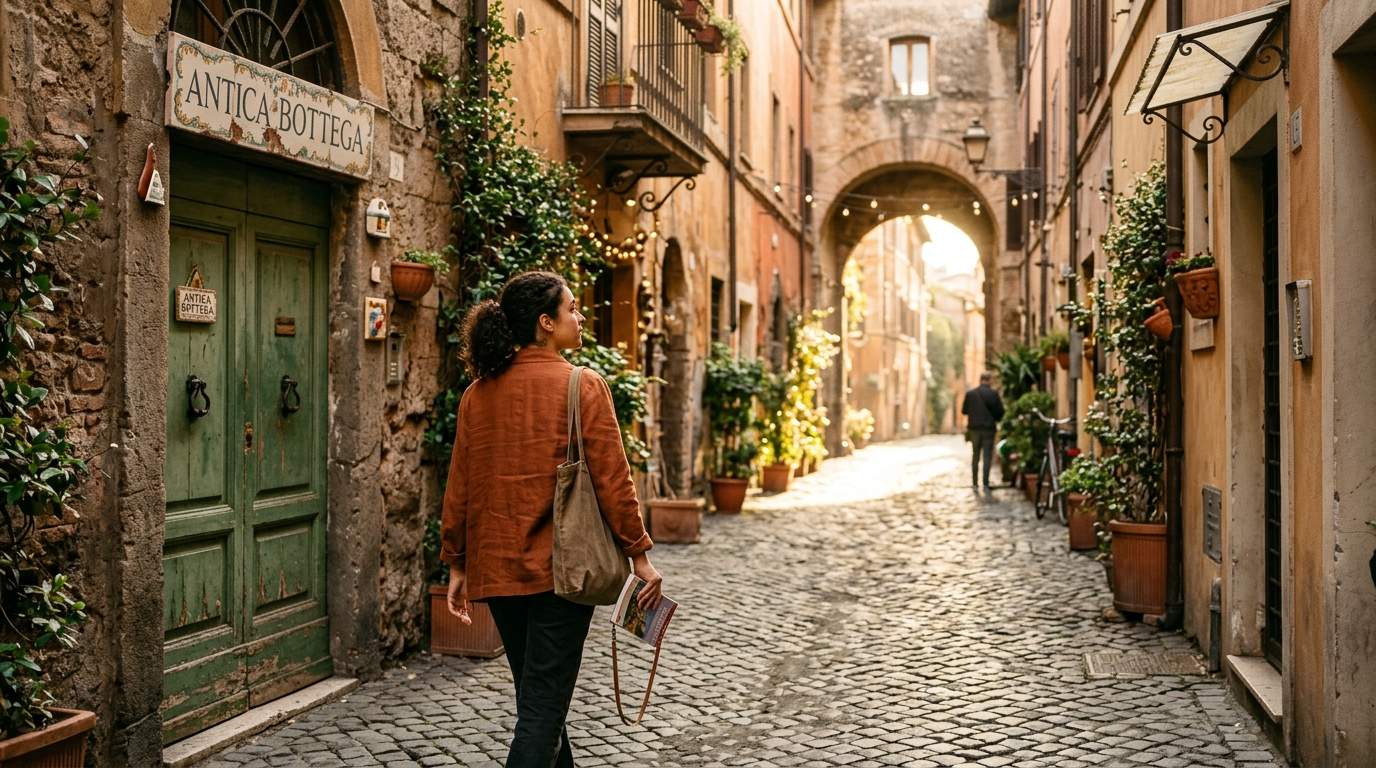
The late afternoon sun slanted through a narrow archway in the Monti district, illuminating dust motes dancing in the golden light. A tiny, chipped ceramic sign above a faded green door read "Antica Bottega," and from inside, the clatter of plates and muffled laughter hinted at secrets beyond the usual tourist trail. I paused, taking a deep breath of air that smelled of ancient stone, brewing coffee, and distant pine. This was Rome. Not the Rome of selfie sticks and aggressive gladiators, but a Rome that whispered, "You're finally home." And honestly, after dodging one too many overpriced "authentic" experiences, finding moments like this felt like striking gold.
Forget the frenzied scramble at the Trevi Fountain, where you practically need a grappling hook to get close enough for a coin toss. My heart truly belongs to Piazza della Madonna dei Monti. It’s tucked away in the bohemian Monti neighborhood, just a stone's throw from the Roman Forum, yet it feels a world apart. I spent an entire afternoon there, perched on a fountain ledge, watching local kids kick a worn football while their parents chatted over aperitivos. No high-pressure street vendors, no tour groups jostling for space. Just the hum of authentic Roman life. A local nonna, noticing my curious gaze, even offered me a bite of her freshly baked pizza bianca, gesturing wildly about how "the real Rome tastes like this, not what they sell at the Colosseum!" A simple gesture, priceless.
Let’s talk food, because honestly, what’s Rome without devouring your weight in pasta? The golden rule: if the menu has pictures and is in six languages, run. My go-to strategy for high-performance feasting involved diving into trattorias and osterias down side streets, a block or two away from any major landmark. For a true Roman carbonara, I once ducked into a place called Trattoria da Enzo al 29 in Trastevere (yes, it’s popular, but for a reason – and still less scammy than many). My friend and I split a dish of Cacio e Pepe and an Amatriciana, washing it down with a carafe of house wine for less than €30 total. Compare that to the €25 per dish you'd cough up near the Pantheon, and you start seeing the matrix.
Now, about that €20 gelato in the title. I didn’t pay it, but I’ve seen enough unsuspecting tourists fall victim. Authentic gelato isn't piled high like a neon-colored mountain, nor does it have artificial fruit. Look for subtle colors (banana should be off-white, not bright yellow), covered tubs (to protect from air), and a short, seasonal ingredient list. I swear by Giolitti near the Pantheon (yes, a bit famous, but consistently good and reasonably priced if you avoid the sit-down service) or Fassi 1880 for old-school vibes. My usual cost for a two-scoop cone? Between €2.50 and €4. That's a solid 80% savings right there, for a far superior product. Don’t let them upsell you on cream!
Navigating Rome can feel like a game of Frogger, but it’s remarkably walkable. I clocked 20,000 steps daily, often forgoing the Metro or bus unless traversing significant distances. This isn't just about saving a €1.50 ticket; it's about discovering the tiny courtyards, ancient ruins peeking through modern buildings, and unexpected street art you'd miss underground. When I did need public transport, a 24-hour bus ticket at €7 got me everywhere. One sweltering afternoon, a bus ride from the Vatican to the Borghese Gallery became a cultural experience in itself, complete with an elderly woman loudly critiquing the driver's turn and a group of students serenading us with an impromptu ukulele performance. No Uber surge pricing here!
Everyone flocks to St. Peter's Basilica and the Vatican Museums. And while impressive, the queues and entry fees can be daunting. My "reverse travel" approach involved a more contemplative, and free, experience. I skipped the official museums and instead headed to the Vatican Grottoes, located beneath St. Peter's Basilica itself. They're free to enter and offer a fascinating, often quiet, glimpse into papal tombs and the foundations of the old basilica. The entrance is typically near the confessionals inside St. Peter's, often overlooked. The hushed reverence down there, standing among centuries of history, felt far more impactful than elbowing through the Sistine Chapel's crowds.
Just a short walk from the Colosseum, yet completely ignored by most tour groups, is the Basilica di San Pietro in Vincoli. This isn't just another beautiful church; it houses Michelangelo’s breathtaking Moses statue, part of the tomb of Pope Julius II. The sheer power and detail in Moses’s eyes alone are worth the visit. But the real "hidden secret" in this church are the chains believed to have bound St. Peter in Jerusalem and Rome. It's free to enter, usually uncrowded, and offers a moment of profound artistic and historical reflection without the circus. I remember standing there, almost alone, thinking, "This is the art and history I came to Rome for, not the selfie sticks."
For the ultimate Roman sunset, ditch the crowded Pincio Terrace or Palatine Hill. My personal favorite, and a true gem, is Janiculum Hill (Gianicolo). I walked up from Trastevere just before dusk, finding a prime spot near the equestrian statue of Garibaldi. The panoramic views of Rome, with the dome of St. Peter's silhouetted against an impossibly orange sky, are simply unparalleled and absolutely free. There's a small cannon that fires daily at noon, but the evening atmosphere is pure magic. Afterwards, instead of plunging into Trastevere’s main piazza with its bustling, tourist-heavy restaurants, I veered into the quieter, darker alleyways. I found a tiny enoteca (wine bar) where the owner poured me a regional Lazio wine, no menu, just his recommendation, for €5. We discussed local football for twenty minutes, and I left feeling like I’d just had dinner with an old friend.
Rome isn't just a city; it's an experience waiting to be personalized. By embracing a little "reverse travel" and a lot of local savvy, you can unlock its true magic without emptying your wallet or getting lost in the crowd.