The tongue that licks your hand: a kiss or a stress questionnaire?
- Quick Tags: dog licking behavior, canine stress signals, dog anxiety signs, why dogs lick people
- Editor: Editorial Team
- Updated: Aug,01,2026
- Views: 291.3k









You come home after a long day. Your dog, Milo, rushes to you, tail spinning like a helicopter. He jumps up and immediately starts licking your hand – long, warm, insistent strokes. “I missed you too, buddy,” you say, melting into his affection.
But later that evening, Milo licks your arm while you watch TV. Then your knee. Then the sofa cushion. He licks until you pull your hand away. You feel annoyed. “Why won’t he stop?”
Here is the uncomfortable truth: that “kiss” you have been collecting for years is often not love at all. It is Milo filling out a questionnaire about your mood, his anxiety, and the state of your household – one tongue stroke at a time. And when licking becomes constant, it may be a distress signal, not a devotion.
Dogs experience the world largely through their mouths and noses. Your skin carries a chemical signature – sweat, lotion, remnants of lunch, and most importantly, pheromones that reveal your emotional state.
Studies suggest that dogs can detect cortisol (stress hormone) and adrenaline in human sweat. When Milo licks your hand after you have had a hard meeting, he is not consoling you. He is sampling your chemistry to decide if the environment is safe. The licking is data collection, not a hug.
One of my clients noticed her dog licked her obsessively every evening. She thought it was love. Then she realized she was always arguing with her teenager at that hour. The dog was not kissing. He was monitoring conflict.
These common interpretations keep owners stuck in a loop of misunderstanding.
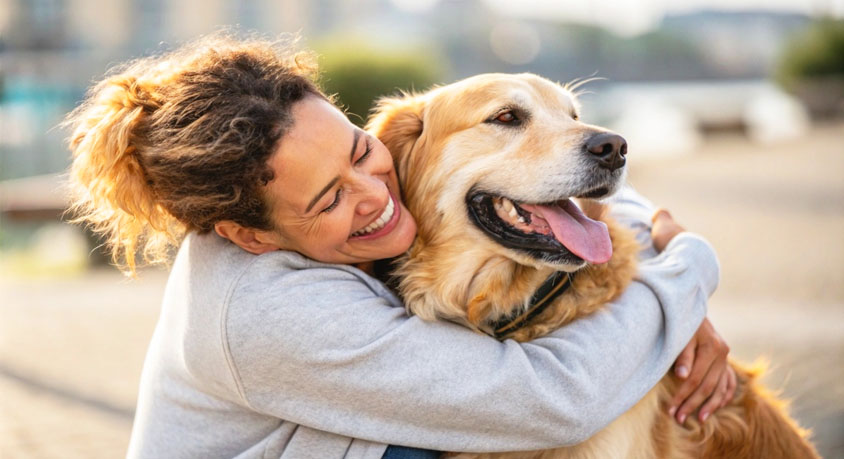
In dog social structures, licking is often an appeasement behavior – a way for a lower-ranking or anxious individual to say “I am not a threat.” A dog who licks your face excessively may actually be nervous around you, not bonded to you. Watch his body: soft and wiggly, or stiff with flattened ears?
Ignoring excessive licking does not teach calm. It teaches your dog that his signals are not working, so he tries harder – licking faster, more persistently. This is how cute greetings turn into compulsive, annoying habits.
Not every lick is a worry. A few greeting licks are normal. These three patterns need attention.
If Milo stops chewing a treat to come lick your leg, or pauses mid-play to lick the floor, that is displacement behavior. He is using licking to manage internal discomfort – often nausea, dental pain, or general anxiety.
A dog who licks your left hand (but never your right), or always licks your knee after you wear a certain perfume, may be reacting to a specific scent cue linked to a past stressful event. Keep a log. Patterns emerge.
When a dog licks pillows, carpets, or your couch cushion repeatedly, it is rarely a nutrient deficiency. It is often a repetitive stress loop – similar to a human biting nails. Increase exercise, offer a lick mat with frozen yogurt, and consult a behaviorist if it persists.
You do not need to eliminate licking. You need to redirect the drive and lower the underlying stress.
Fill a rubber lick mat with plain yogurt, pumpkin puree, or wet food. Freeze for two hours. Offer it to Milo before his usual licking hour. The licking motion is still there – but now it is attached to food, not anxiety. Most dogs shift their focus within a few days.
Allow three polite licks when you come home. Then stand up, turn away, and offer a toy. This teaches Milo that licking opens the greeting, but it does not control the interaction.
Some licking has nothing to do with emotion. These physical causes are often missed.
Dogs with upset stomachs lick surfaces obsessively – floors, walls, your hands. The licking produces saliva, which buffers stomach acid. If your dog licks and also swallows frequently, or licks right after meals, ask your vet about antacids.
A sore tooth or gum inflammation can cause a dog to lick people or objects more than usual – partly as a distraction, partly because the mouth feels “wrong.” Bad breath, dropping food, or pawing at the mouth are red flags.
I worked with a family whose Lab, Gus, licked every visitor until their arms were soaked. They felt embarrassed. Guests stopped coming over. We discovered Gus had early arthritis – the licking was his way of coping with constant low-level pain. After pain medication and a daily lick mat, Gus still greeted guests. But he gave two polite licks, then fetched a toy instead.
“I thought he was just overly friendly,” his owner said. “He was just overly uncomfortable.”
Next time Milo’s tongue finds your hand, do not just melt. Pause. Look at his eyes – are they soft or wide? Look at his ears – back or relaxed? And if that tongue keeps moving long after the hello is over, let it be a question, not a kiss.
Your dog loves you. But sometimes, even love speaks in a language that sounds less like devotion and more like distress. Learning to hear the difference is the kindest thing you can do for both of you.